Uncompromising Simplicity
Enterprise application delivery and security in a single visual management experience that teams pick up quickly.
Enterprise ADC and application security platforms can be powerful — but that power often comes with complex interfaces, vendor-specific scripting languages, scattered modules, and long learning curves. TR7 is designed to reduce that operational burden.
ADC, WAAP, AAM, GTM, and DDoS capabilities come together in one management experience. Traffic rules are built with visual IF/THEN logic, health is monitored through color-coded indicators, and diagnostic tools run from the same console. The operations team doesn't have to spend weeks searching through interfaces to understand the product.
Enterprise power. Cleaner operations.
TR7 delivers advanced application delivery and security capabilities without burying them in scripting languages, scattered consoles, or module complexity. New team members ramp up faster; senior engineers retain detailed control.
Understandable Operations Instead of Complex Management
On traditional ADC platforms, powerful capabilities often create dependency on specialists. TR7 offers the same capabilities in a more readable, more manageable, more team-friendly model.
See. Build. Run.
Manage complex traffic decisions through readable visual flows.
You don't need to write a custom scripting language to build a traffic policy on TR7. You select conditions, combine them with AND/OR logic, and decide which action to apply. The traffic rules engine, content-aware rules, and smart ACL conditions run within the same management experience.
The visual flow engine is designed to simplify everyday operations. For advanced scenarios, the Expression FX engine, a comprehensive REST API, and the built-in web CLI extend the same policy model with deeper control. TR7 is not only a no-code tool; it is a platform where the engineering team can reach all control layers when needed.
vHost-Based Service Definition
Pick an IP and port, add a virtual server name; TR7 manages the related application as an isolated vService. Each vService runs independently with its own WAAP rules, certificates, rate limits, and backend pools. Multiple applications on the same IP can be managed in a more orderly, more understandable way.
Health at a Glance
Every object has a color-coded status indicator. On clustered deployments, you see the status of both appliances from a single console. No separate monitoring tool is required.
Built-In Web CLI
No need to open an SSH session. Access the full-featured CLI from the web interface with tab completion, command history, and context-aware suggestions. tcpdump, ping, traceroute — all from the browser.
Dynamic Flow Panel
A management area that brings traffic, security, and operations context together on a single screen.
View, change, and monitor all your security and traffic policies on a single flow. Instead of losing context across separate screens, follow an application's traffic flow, security decisions, and operational state on the same panel.
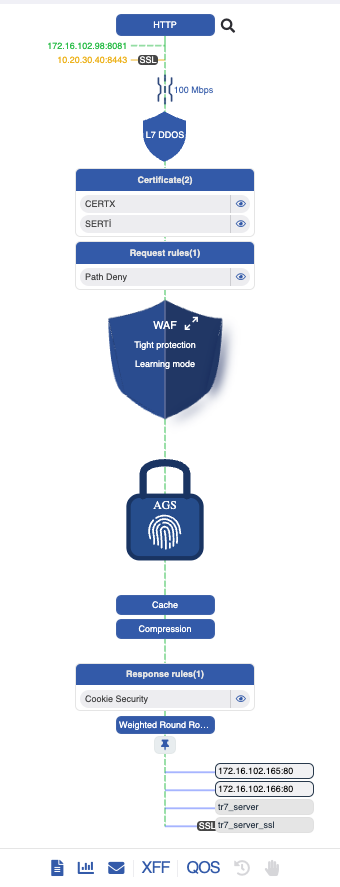
Visibility
Monitor traffic flow live; see real-time counters for every vService, every rule, every action. With live traffic tracking, filter every connection — including JSON body content — by condition, without extra tools.
- Real-time vService, rule, and action counters
- All security components on a single console
- Multi-dimensional drill-down — geography, ASN, UA, JSON path
Policy
Ready-made templates for common scenarios; the Expression FX engine for advanced needs. Instead of copy-paste between screens, chain conditional logic in a single interface.
- Drag-and-drop rule builder
- Industry templates + custom policy
- Controlled cross-environment rollout
Insight
Threats are on the screen, not buried in a report. With adaptive DDoS baseline learning, the system observes your traffic patterns; operator-confirmed thresholds become applicable policies. WAAP attack reporting shows what was blocked and which policy fired in seconds.
- Behavioral analytics + prioritized recommendations
- Predictive trend analysis
- Contextual risk scoring
Debugging & API
Protocol-level inspection, request/response correlation — all in the console. With the built-in network diagnostics, tcpdump, ping, and traceroute run from the browser. Every UI operation is also accessible via REST API — fully parallel for CI/CD and infrastructure-as-code integration.
- Request/response correlation + packet-level inspection
- Configurable traffic capture
- Full RESTful API + sample code generator
Key Benefit
One console; one flow; one language. The operations team moves into advanced use from day one without losing context.
Combines Five Product Categories on a Single Platform
In traditional architectures, application delivery, web security, identity-based access, global routing, and DDoS protection are often run on separate appliances with separate management tools. TR7 brings these layers together in a single platform architecture.
Application Delivery Manager (ADC)
Multi-metric adaptive routing with 14 algorithms and zero-touch deployment modes.
Web Application and API Protection (WAAP)
Dual OWASP coverage and LLM prompt-injection defense with 10,000+ active signatures.
Global Traffic Manager (GTM)
3 datacenter selection sources, 9 algorithms, and boolean compound health scenarios.
Application Access Manager (AAM)
9 native authentication providers, a visual drag-and-drop policy builder, and a built-in portal.
DDoS Protection
L3-L7 multi-layered mitigation with adaptive learning, behavioral analysis, and hardware-accelerated packet processing.
One platform; one management experience; less operational complexity. With the Licensing Guide, you can review the bundle and commercial model that fit your needs in a few minutes.
The same operating language from the first rule to the thousandth service.
TR7 offers an operations experience that starts simple but doesn't fragment as you grow. A small application rollout and a multi-region enterprise architecture are managed with the same console logic.
See the Simplicity Live
Request a live demo and experience TR7's operational simplicity from your first rule to your thousandth service. Or use the Licensing Wizard to find the model that fits you in a few minutes.
Capability scope, performance figures, license models, and support tiers described on this page may vary depending on the deployment, license package, hardware model, and selected support program. For detailed scope, please review the relevant product, license, and support pages.